Total Pageviews
Tuesday, 30 July 2013
Why microbes could be changing the world's weather patterns?
Monday, 29 July 2013
Mars' atmosphere was "oxygen rich"
Sunday, 28 July 2013
How does the sun "burn" if there is no oxygen in space?
Why has the UK had such hot weather this July?
June saw the weather across the UK as decidedly mixed with some good weather, but interspersed with this, we saw many spells of wet and windy weather. This was due to the jet stream being across the Atlantic, slightly further south than what is normal for this time of year.
A major change took place just after the start of July as the jet stream took a dramatic shift northwards. This meant that the newly placed jet stream deflected the bad weather towards Ireland and Scandinavia. Then high pressure was dominant across the UK, in meteorological terms this is known as a blocked pattern. At this time of year, high pressure generally signals good weather and this coupled with the strength of sun can bring very high temperatures
One thing unusual for the UK is that most of the UK has benefited from this good weather, and these high temperatures haven't been confined to one area. Also we have had very few thunderstorms in the last few weeks. Most people think that these always accompany the hot weather, in this case it is because the hot weather isn't from France or Spain.
However this hot weather isn't good for everyone, the Met Office and Public Health England have been collaborating to provide advice through the Heat Health Watch.
Compared to last year, this hot weather is in complete contrast when we experienced a succession of weather systems that we got from the Atlantic. There was no recorded change to the position of the jet stream it was a constant feature throughout the summer of 2012.
Friday, 26 July 2013
What are black holes?

![]() |
| This image of the center of the Milky Way galaxy was taken by the Chandra X-ray Observatory. Image Credit: NASA/CXC/MIT/F.K. Baganoff et al. |

What is Solar Wind?
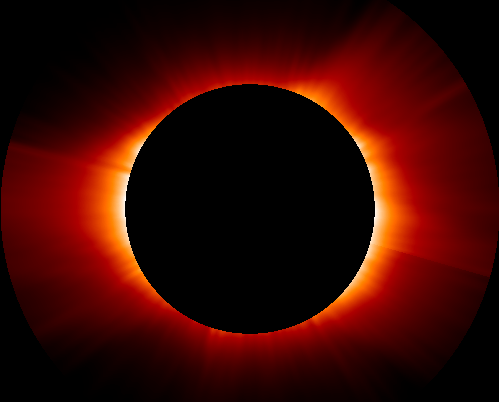
Solar Winds are streams of energized charges particles, these are mostly electrons and protons. The winds flow from the sun through the solar system. Sometimes these can be of speeds as high as 900km/s and at a temperature of 1 million degrees celsius.

The Sun's corona, taken by the SOHO satellite with a special camera that blocks out light from the Sun's main disk. Courtesy of SOHO consortium. SOHO is a project of international cooperation between ESA and NASA."
The solar wind is what blows the tails of comets back away from the bodies of comets as they go through the solar system.
How do the northern lights form?
The aurora borealis (the Northern Lights) and the aurora australis (the Southern Lights) have always been on people's wish list to visit, but how they actually form is a mystery to many people. Both of the auroras surrounding the north and South Pole occur when highly charged electrons from solar wind (see next post) interact with elements within our atmosphere. These particular solar winds can be up to speeds of 1 million miles per hour! They then reach earth some 40 hours since leaving the sun. They follow the lines of the magnetic field (much like you would see on a diagram). The solar winds then flow through the earths magnetosphere, this is a teardrop shaped area of highly charged electrical fields.
When the electrons enter the earth's paper atmosphere they come across atoms of oxygen and nitrogen at altitudes from 20 to 200 miles above the earth's surface. The colour of the aurora depends on which atom is struck and the altitude at which this happens.
- Green - oxygen, up to 150 miles in altitude
- Red - oxygen, above 150 miles in altitude
- Blue - nitrogen, up to 60 miles in altitude
- Purple/violet - nitrogen, above 60 miles in altitude
The northern or southern lights generally happen along the "auroral ovals", these are at the centre of the magnetic poles and they roughly coincide with the Arctic and Antarctic circles. They can however, appear further south when there is alot of sunspots, these occur in a rough 11 year cycle the last happened in 2011/12 where many people enjoyed the northern lights outside their normal range.
Wednesday, 24 July 2013
Contact details
What causes heat haze?
The appearance of any object depends on the optical properties if the air between you and the object or person. These are determined by the density and temperature of the air, so any source of heat, maybe from a barbecue or the sun can cause uneven changes to the density of the air. These changes produce optical distortions which we know to be heat haze.Tuesday, 23 July 2013
How is our genetic code stored?
How does sunscreen work?
Sunscreen is made up of a mixture of organic and inorganic
particles to protect your body from potentially harmful UV radiation. The
sunlight is made up of various different types of UV radiation; these include
UVA, UVB and UVC radiation. Each of these types of UV radiation is of different
wavelength which makes the sunscreen easier or harder to protect your skin from
burning. For example UVC radiation has a wavelength of 280 -100mm, this very
short wavelength radiation are blocked by the earth’s atmosphere even before it
reaches you. But not all sunscreens protect against UVA radiation and over
exposure to this type of radiation can, over time cause skin cancer.
The organic particles within the sunscreen (often a chemical
called octyl methoxycinnamate or oxybenzone) absorb the rays; these are then dissipated
within the body as heat which therefore prevents your skin burning. The
inorganic particles (often zinc oxide or titanium dioxide) reflect and scatter
the radiation which forms a physical barrier and therefore also helps prevent
the skin from burning. It is these inorganic particles in the sunscreen which
makes it appear white; however nowadays the particles are so small the
sunscreen is clear so you can’t see it.Is the sun actually good for you?
Thunderstorms earlier today across the south east of the UK
marked the climax of the heat wave that brought the hottest temperatures in
seven years. The temperature even reached 33oC in Heathrow, London
yesterday. But is the sun actually good for you?
Amongst other effects such as skin cancer or going blind, the
“Tortoise face” is one that all of us are presumably keen to avoid, a
combination of UVA and UVB radiation (different types of UV radiation) can cause
the skin to thicken and loose its natural elasticity. This could well lead to
premature aging, wrinkles and bags under your eyes!