Total Pageviews

Showing posts with label america. Show all posts

Wednesday, 20 January 2016

The Great Salmon Rush

Grizzly Bears are part of one of nature's greatest events, every year they gather, all to get the best catch. Check out this video of the event - it's quite incredible!

Check out my previous post on Grizzly Bears 


Sunday, 17 January 2016

Grizzly Bears

Scientists classify any North American subspecies of the brown bear as a grizzly bear – although they’ve actually assigned them the name of a “North American Brown Bear”. However it was first given the name of the Grizzly bear due to its characteristic long, ‘grizzly’ hair. Characteristically, they’re very solitary, active animals. They gather once a year for the “great salmon run”- where they gather at rivers to catch the mass migration of salmon. These bears have one of the lowest reproduction rates across the whole of North America. This is due to many reasons, one being that they reach sexual maturity at around 5 years old – a lot later than most land mammals in North America. When they do reproduce, a female bear produces on average 2 cubs a litter. Once the cubs leave or are killed, the female might not produce a second litter for perhaps 2 or 3 years later.

Surprisingly, Grizzly Bears play a huge ecological role; they have mutualistic relationships with some plants, spreading their seeds. The bears actually help by increasing species diversity in the plants on the forest floor.

Tuesday, 5 January 2016

The Bear Family and Me


Happy New Year! Later on this week, I've got a 2015 Science Review post coming, but for now, I thought I'd tell you about one of my favourite Christmas TV series I watched over the festive period. The Bear Family and Me was one of the many wildlife TV programmes I watched over the Christmas period - in fact, we watched the recording of it whilst we were waiting for midnight on New Year's Eve. The Bear Family and Me was probably one of the best programmes I've watched in a long time - although I can't call it between the other ...Family and Me programmes. The series follows wildlife cameraman, Gordon Buchanan and a series of black bears. During the 3 part series , he follows a family of bears and nearby families, following their story, getting to know the real bear behind the headlines. He arrives in Minnesota in the spring, with one major challenge to begin with - gaining the bear's trust. Understandably, he's scared of them- they've had a pretty hard time in the press and they're well known for becoming angry when they're hungry. When local researchers introduce him to one particular family, Lily and her cub, Hope, his fears disappear. During the second episode, he arrives to discover that Lily has abandoned her cub - Gordon and the researchers track Hope down in attempt to reunite her with her Mum and to keep her alive. In the final episode, the journey takes an unexpected turn as far as Hope is concerned, Gordon also turns into a bear body guard when he's out protecting the bears from hunters. Perhaps the most important thing Gordon achieved was that he became part of their family and was accepted - he achieved the seemingly impossible and managed to get close to the bears, regularly feeding them out of his hands. Bears aren't the animals I'd like to meet alone on a dark night, but I certainly would love to go and see them in the wild.
 

Friday, 18 September 2015

The Sun Bear | #WeirdestAnimals

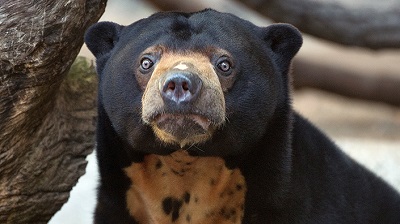
This amazing bear is the smallest member of the bear family and lives in the dense forests of Southeast Asia.

They take their name from the bib-shaped golden patch on their chest which legend says, represents the rising sun. They're also nicknamed the dog bear as they have the same kind of build a short muzzle nose. To stop them overheating, they have a sleek, black coat which is also thick and coarse to provide protection from things like twigs and branches - but also to keep dry!

Ironically Sun bears are nocturnal, lumbering through the forests by night, snacking on berries and so on- everything even up to small rodents. They also have a huge tongue which is perfect for extracting honey from bees nests - giving them their other nickname, the 'honey bear'.  We don't actually know a lot about honey bears, we don't even have enough data to know how many there are in the wild. Having said that, because of the high deforestation and poaching levels scientists aren't hopeful - they might actually be in danger of extinction.


Tuesday, 15 September 2015

The Majestic Grizzly Bear

Grizzly Bears, one of the most majestic animals in the world, protective, yet also one of the cutest animals, EVER! They're mostly found in North America and Western Canada, as they are very adaptable and can be found in most places, from dense woodland and open plains to Arctic Tundra. In fact, North America is home to over 50,000 bears! They are also very hungry! They eat everything from dead animals and insects to berries and fish! As the summer draws to a close they enter a phase called hyperphagia. This last around 2-4 months when the bears vastly increase their calorie intake in preparation for the winter. Bears on the whole are actually quite solitary animals and not particularly territorial, surprisingly this is ideal behaviour as far as scientists are concerned. The bears spend a lot of their time rubbing their backs against trees where they leave their scent and hair. This is perfect for biologists as they can collect DNA from the local bears without being an interference. Grizzly bears are actually one of the slowest reproducing land mammals as the females don't reproduce until they're four or five. If the female doesn't put enough weight on throughout the course of the year, then the female doesn't reproduce that year because she won't have the energy or resources to raise the cubs


Monday, 14 September 2015

The Enchanted Pink Dolphin


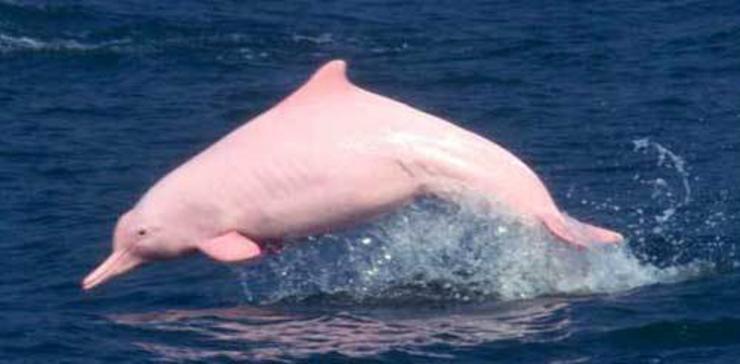
The Pink Dolphin is literally like something out of a fairy tale. In total, there's five species of dolphins that reside in out rivers, but one of the most popular of these is the pink dolphin who lives in the Amazon River. Even though these Dolphins are comparatively popular along the Amazon River they're still endangered like the other species of dolphin.

These incredibly unique dolphins have an incredibly varied diet, from crabs and small fish to bigger animals like catfish and even small turtles. The dolphins can also move their head up to 180 degrees thanks to some of their vertebrae not being fused which is great for hunting in shallow waters.

The Pink Dolphin is also often Albino making them look very unique but this also brings them loads of different health problems. For example if they're pink they have a lot lower levels of the pigment melanin, which on top of protecting them from the sunlight, it also plays a vital role in their eyesight. Without it they have extremely poor vision and that's why we don't often see them!


Saturday, 5 September 2015

The Star Nosed Mole | #WeirdestAnimals


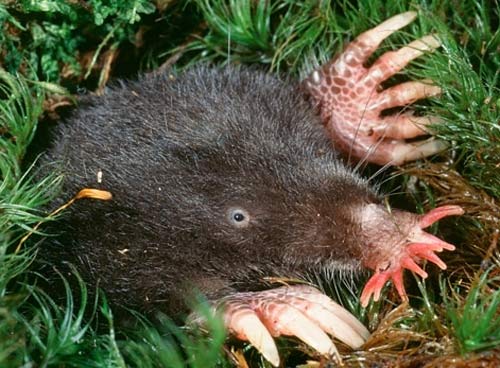
Granted, these are one of the ugliest animals on the planet but they're still pretty cool nonetheless! They have one of the most bizarre noses known to man. They're snouts are lined with more than 25,000 sensory receptors to help the mole feel its way through its underground lair.  Like other moles, they have an underground network of tunnels around North America where they're most often found. They pretty much spend their lives living in complete darkness, they're bodies have adapted to be completely blind - purely because it doesn't need good sight! Because they are completely blind, they rely on their star shaped nose, mainly to decided whether something is edible in a split second. It's nose is so powerful it can also sniff out food underwater.

The Star Nosed Mole is awesome.


Saturday, 4 January 2014

NASA: Tales of Triumph and Disaster - Part 1


40 years ago history was made worldwide, when the first man was landed on the moon. This will tell the ever continuing story of endeavours undertaken by the USA at the forefront of manned and unmanned space exploration.


Alan Shepard Biography Photo
The Astronauts part of the Mercury Mission
On July 1958 NASA was established, with one simple brief: to beat the Russians in the space race.  Drawn from military training pilots the hope was to get humans safely into space, but quickly and to a deadline.

During the 1950’s the American’s were still trailing the Russians in the space race.  NASA firstly established the Mercury programme to train seven astronauts to be ready for space. One included Alan Shepard who NASA selected for America’s first manned mission into space. Scientists at NASA were shaken as Russia launched their first manned space flight on the 15th April 1961, only a few weeks before NASA’s first manned mission was to be launched.

On May 5th Alan Shepard’s flight was still a history-making event. Whereas Yuri Gagarin had only been a ‘passenger’ in the vehicle, Shepard was able to manoeuvre the Freedom 7 space capsule himself.  Shepard made a safe return to Earth with a splashdown at sea and recovery by helicopter, even better still this was all captured on camera and broadcast to millions worldwide. As he returned to mainland America, he was honoured with parades in Washington, New York and Los Angeles.

This historic event signalled the first of many missions by NASA and further joint projects with various contries, including Great Britain, find out more in “NASA: Tales of Triumph and Disaster – Part 2” , coming soon)

Thursday, 2 January 2014

The First Man in Space

Yuri Gagarin
Happy New Year!


On 12th April 1961 history was made when Russian cosmonaut Yuri Gagarin (9th March 1934-27th March 1968)  became the first man in space with a 108 minute flight orbiting the earth once.


In 1960 he was shortlisted for the Vostok 1 space programme in an attempt to build on the success of the Sputnik 1 programme just three years earlier. Rivalling German Titov, Gagarin managed to impress the space programme director more so and was selected for the space programme in 1961.

Shortly following his resounding success with the mission he became an instant worldwide celebrity, he visited several countries including Britain in 1961. Unfortunatley he diedin a military training flight on the 27th March 1968 aged just 34.

Although he was awarded many medals and titles, including Hero of the Soviet Union, the nation's highest honour. Vostok 1 was his only space flight but he did serve as backup crew to the Soyuz 1 mission.

Less than a month later an American astronaut, Alan Shepard became the first American in space.

First news headlines following the mission
 The U.S and Soviet Union since this have carried out cooperative missions, the first of which happened in 1975. The mission was called "The Apollo-Soyuz Test Project" and it was designed to test the capability of docking systems for future American and Soviet spacecraft, something which later opened doors into future joint manned flights.


Tuesday, 30 July 2013

Why microbes could be changing the world's weather patterns?

Microbes are everywhere, both good and bad, and scientists at NASA believe that these microbes could be changing our weather patterns, both  here in the UK and worldwide.  
Research has been carried out across NASA compounds. One these in Texas.To carry out the experiment they send up, into space, a balloon and a mesh which collects the samples of the microbes. They collect samples at heights 70,000 ft to 10,000 ft. Scientists have analysed the aerodynamic properties of these microbes and they have found that these particular molecules can be suspended in our atmosphere for up to three weeks. 

A process called "Ice Nucleation" is happening all of the time in our atmosphere, this means that any solid particles in our atmosphere makes it a lot easier for ice to form around the solid particle however big or small this is.

 For crystals, whatever sort they are need something solid to form around, if this happens then the ice crystals can be a lot bigger than without the solid particle (in this case the microbe). When ice forms in our atmosphere, clouds form. This will eventually make it rain. 

So, if there are more microbes in the atmosphere it is easier for ice, therefore clouds to form. More clouds, mean that it will rain more.