Total Pageviews

Monday, 14 March 2016

What is Meldonium? | Drug Profile

Meldonium was banned because it aids oxygen uptake and endurance.

Meldonium, sometimes called mildronate, taken by Maria Sharapova for virtually 10 years was originally designed to treat ischemia. Ischemia is a condition in which there's a reduction in blood supply to the body tissue, it also might have benefits for diabetes sufferers.

Meldonium adjusts the body's use of energy, stimulating glucose metabolism and helping to clear a fatty build up in arteries. You can get Meldonium mainly in Russia and Latvia but the drug is banned in the US.

Surprisingly, the drug was often given to Soviet troops in the 1980s to boost their stamina whilst fighting in Afghanistan. Since Maria's story came out, the manufacturers of Meldonium have come out to say the normal course of treatment is 4-6 weeks. Having said that, this all depends on dosage.

Of course, the level of the benefits depend on the dosage, something of which Maria Sharapova will need to provide strong evidence of when she goes before an ITF panel.
 

Sunday, 13 March 2016

What is homeostasis?


Animals (including us) use a system called homeostasis to maintain a constant internal environment. This keeps temperature, pH and blood glucose level all constant.

There are a number of systems in place to keep this all level, these are called homeostatic systems. They detect a change and respond by negative feedback. The systems involve receptors (these detect the changes), a communication system (to communicate the changes) and effectors which make the change.

Hypothermia occurs when the body temperature is too low, this involves positive feedback. Below 35C and you're hypothermic. It happens when heats lost from the body quicker than it can be produced. As body temperature falls the brain doesn't work properly, shivering stops and the body temperature falls even more - basically, you're in trouble!

Positive feedback takes the body temperature further away from the normal level, body temperature continues to decrease unless some action is taken! - this system of positive feedback isn't involved in homeostasis because it doesn't keep your internal environment constant.
 

Thursday, 10 March 2016

How does you brain control your heart rate?

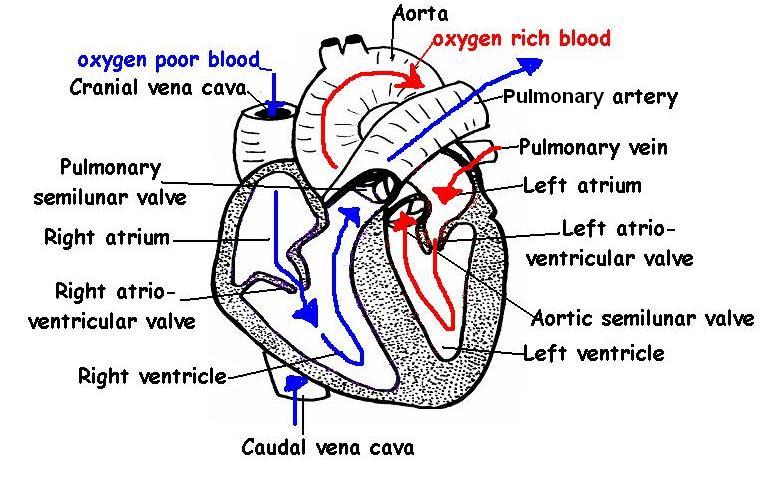
Your heart is a muscle, it pumps blood around your body as it contracts. Inside your heart is essentially a network of nodes and vessels, these help nerve impulses from your brain tell it when to contract.

One of these nodes, the SAN (sinoatrial node) generate these electrical impulses which cause the heart to contract. The rate at which the SAN works (essentially your heart rate) is unconsciously controlled by part of your brain called the medulla. Animals (including humans) alter their heart rate to respond to certain stimuli - for example, your heart will beat faster if you've just been running. This system ensures that your body receives enough blood and oxygen to function.

For the body to respond to something, it first needs to be detected. There are two main types of receptors which help to control  heart rate - baroreceptors and chemoreceptors.

Baroreceptors - these detect pressure in the aorta and vena cava. They're stimulated by high and low blood pressure. If you think about barometers which detect atmospheric pressure changes, that's essentially what a baroreceptor does, just in your heart!

Chemoreceptors - these are chemical receptors, they're found in the aorta and carotid artery (a major artery in the neck) and also in the medulla. The chemoreceptors monitor oxygen level in the blood, carbon dioxide level and pH. Knowing the pH level is very useful because its an indicator of oxygen level.

Once these receptors detect a change, electrical impulses are sent to the medulla along sensory neurones. The medulla processes this information and sends impulses to the SAN and the heart rate is adjusted.

This post specifically relates to AQA A-Level Biology Unit 5 - Responding to the Environment

Wednesday, 9 March 2016

What are Fertilisers?


I'm sure we've all either used fertilisers or been around your parents when they've been using fertilisers. Fertilisers provide crops with chemicals needed for growth, like nitrates. This is because crops use up minerals as they grow and the soil can't usually supply enough minerals to fulfil demand.


There are two main types of fertilisers - natural and artificial. Natural fertilisers are made up of organic matter - like manure and sewage sludge. These don't have a set combination of minerals - there's no 'recipe' pretty much just because they're natural.

Artificial fertilisers are man made using inorganic material - unlike natural fertilisers there is a 'recipe' and the recipe depends purely on what you're growing and where you're growing it. These contain pure chemicals like ammonium nitrate in the form of powders or pellets.


Whether they're artificial or natural, they provide crops with the minerals they need for growth, like nitrates. Over time, this level needs to be replenished because they use up the minerals as they grow. The job then falls to the farmers who decide how much to use, too much is too expensive, too little and it would get washed away before it had an affect.  

When fertilisers are washed off of fields (leached), this causes the problem of Eutrophication. Excess fertiliser causes an algal bloom, this blocks light, in turn, it reduces photosynthesis. This means that submerged plants can't carry out photosynthesis, they can only respire so die. Saprobiotic microorganisms aerobically respire, over time the oxygen supply is depleted and fish also die.


This article specifically relates to AQA A2 Biology Unit 4

Monday, 7 March 2016

Maria Sharapova: "I've failed a drugs test" | What is Meldonium?


Former world number one, Maria Sharapova has been taking a drug called Meldonium for 10 years. On January 1st, this year, it was entered on the banned list – Sharapova wasn’t informed and she failed a drugs test at the Australian Open.

She’s been taking it since 2006 due to persistent health issues, now, the five time grand slam champion’s not aware of the sanctions she’ll face as a consequence. Since Wimbledon last year, she’s only played four tournaments. This year, she’s only played the Australian Open. She’s currently struggling with various different injuries but it’s likely this revelation will have an even bigger effect on her 2016 schedule.

It’s quite a controversial drug – it’s used in Russia and Lithuania but USA hasn’t approved the drug. Clinically speaking, it was first used to treat angina and myocardial infarction (heart attacks). It’s also been known to help treat diabetes and some neurological issues. In her press conference, Maria said that she’s got quite a large family history of diabetes. More recent reports suggest that it can improve learning and memory. Weirdly it might also have an effect on testosterone and men’s health.

As far as sport is concerned – this is a metabolic performance enhancer. This basically means that Sharapova - amongst the health benefits she was already taking the drug for, would have an enhanced energy and a stronger heart muscle. In short – she’d have more energy and be able to last longer on the tennis court. It also would have had an improvement with movement coordination and concentration. It also has a positive effect on the energy metabolism of the body – activating the central nervous system.

At this stage, it’s unclear as to what sanctions she would face, the ITF (International Tennis Federation) in conjunction with WADA (world anti-doping agency) will look at various different factors like who gave the drug to her, was she aware of the effects? Whatever sanction she’ll face she, and her team have got  lot of explaining to do.


Glow in the Dark Cats


This might seem a little odd - and a little like someone has just done a pretty good photoshop job, but I promise this is all true! Scientists have actually "created" glow in the dark Cats, Monkeys and fish. In 2007 South Korean scientists inserted the glow in the dark gene then cloned these cats. The end result? Fluffy, florescent felines! They did this through taking samples of skin cells from Turkish Angora cats. They then used a virus to insert genetic instructions for making a red florescent protein. They put this altered nuclei back into the eggs for cloning. You might now be thinking - what's the point? Well, scientists are hoping that they could, eventually create laboratory animals with human genetic disorders - although this does of course, create a massive ethical issue!

Thursday, 3 March 2016

How big of an issue is hearing loss?


Thankfully, I don't know anyone who's got hearing loss (or at least hearing loss which isn't selective!! :)) But according to the World Health Organisation, this is a very big issue. In fact, today is World Hearing Day. Here are the stats...


32 million children worldwide have disabling hearing loss
60% of cases are preventable - only 17% are from birth related causes.
31% of hearing loss cases result from infections


Make sure you're aware of the symptoms to prevent any issues escalating.


Wednesday, 2 March 2016

What is Global Warming?

We hear about global warming all the time - our planet is unique in the sense it could well be the only one with life, so we need to preserve it. But at the moment we're damaging it. This is partly the aim of the UN's Global Goals. This is to ensure that future generations get to enjoy our planet too. Global warming is caused by increasing carbon dioxide levels - this leads to an increase in average global temperature.

Human activity has caused global warming by enhancing what's called the Greenhouse Effect. This is because, greenhouse gases absorb outgoing energy so less is lost to space. To some degree, the greenhouse effect essential to keep planet warm but too much and planet warms up.

The two most common greenhouse gases, carbon dioxide and methane are to blame for this increase.


Burning fossil fuels, farming and deforestation all increases atmospheric concentrations of carbon dioxide. This  effects all organisms and we need to do something about it!

Scott Kelly's Return to Earth | #TimPeakeUpdate


Tim Peake's had some major changes on board the ISS recently - early this morning Commander of the Space Station, Scott Kelly returned to earth after a staggering 340 days in space. He left Earth early last year and hasn't been back since. The job now lies in figuring out Earth - and the minor change of gravity!


Only one person has beaten this record of 340 days which Scott shares with two other Russian crewmates - Valeri Polakov who spent 14 months aboard the Mir Space Station. What's even more special about Scott's time in space is that now, NASA can look at what 11 months in space does to his body, with Scott's identical twin and all because Scott's twin is genetically identical they can directly compare what 11 months in space does to your body.


Across his year in space, he's tweeted 1,000 images, worked on hundreds of experiments, carried out many space walks and above all he's looked at our planet in a totally new way. Follow @StationCDRKelly as he rediscovers planet Earth.