My new book, an A-Z guide to some of the hidden gems of the Animal Kingdom is OUT! Check out the links below:
Total Pageviews
Saturday, 26 March 2016
ANIMAL A-Z: OUT NOW!!!!
Friday, 25 March 2016
MY NEW BOOK! ANIMAL A-Z!!
My new book, an A-Z guide to the Animal Kingdom will be released in the next couple of days on Amazon and Amazon Kindle. The book contains a huge range of animals, from the weird to the wonderful and everything in between. Below is a selection of animals from the book:
There's this and a whole lot more in my book! When it's released, I'll add a link here so you can check it out :)
- The Aye-Aye
- Antelope
- American Alligator
- The Tarsier
- Porpoise
- Seals
- Puffins
- Tasmanian Devil
- The Quagga
- Tigers
- Lions
- Sea Lions
- Clownfish
- The Yellow Billed Hornbill
- The Uakaris
There's this and a whole lot more in my book! When it's released, I'll add a link here so you can check it out :)
What is an ectotherm?
An ectotherm is an animal (perhaps a reptile or fish) which can't control their body temperature internally - they control their body temperature through their behaviour. This might be through a number of ways - including physically moving from one place to another, so from direct sunlight to shade so they don't overheat.
In the case of ectotherms, their internal temperature depends on that of their surroundings and their activity level depends on the external temperature. They're more active at higher temperatures and less active at lower temperatures.
As far as their metabolic rate is concerned, it's variable and they generate very little heat themselves.
Labels:
ectotherm,
external,
homeostasis,
internal,
lizard,
reptile,
sunlight,
temperature
Tuesday, 22 March 2016
Survival Responses in Plants
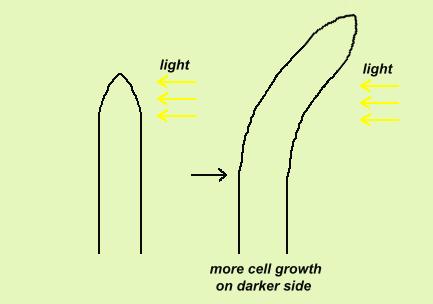
Another type of growth factor are auxins. Auxins stimulate growth of shoots by cell elongation. This is where the cell walls become loose and stretchy, the cell then gets longer. At a high auxin concentration, auxins inhibit growth in the roots. A specific type of auxin, Indoleacetic acid (IAA) is an important type. It's produced in tips of shoots in flowering plants. As the plant works to control it's growth and respond to the stimuli, IAA is moved around. It moves by diffusion and active transport over short distances, across longer distances IAA is moved via the phloem. Different levels of IAA across the plant results in uneven growth of the plant - this means the plant then grows towards the light for example.
Plants, particularly flowering plants need to respond to their surroundings like animals do, in order to increase their chances of survival. They can sense gravity so their roots grow in the right direction. They also respond to light so they can maximise the amount of light they receive for photosynthesis. Plants which climb have a sense of touch, they find things to climb so they can reach the sunlight.
Tropism is this response to directional stimulus. A directional stimulus is just a response to a stimulus coming from one direction. Plants respond to this stimulus by regulating their growth. Positive stimuli is growth towards the stimulus, negative tropism growing away from the stimulus.
The plants responses are brought about by growth factors - pretty much like the plants hormones. This is because they don't have a nervous system like us. They also don't have a circulatory system, hence the reason why growth factors can't be called hormones. Growth factors are chemicals which speed up or slow down plant growth. They're produced in parts of the plant which grows (the shoot tips and leaves). Once they've been made, they move to where they're needed in the plant. One example of a growth factor is gibberellin, this stimulates flowering and seed germination.
Plants, particularly flowering plants need to respond to their surroundings like animals do, in order to increase their chances of survival. They can sense gravity so their roots grow in the right direction. They also respond to light so they can maximise the amount of light they receive for photosynthesis. Plants which climb have a sense of touch, they find things to climb so they can reach the sunlight.
Tropism is this response to directional stimulus. A directional stimulus is just a response to a stimulus coming from one direction. Plants respond to this stimulus by regulating their growth. Positive stimuli is growth towards the stimulus, negative tropism growing away from the stimulus.
The plants responses are brought about by growth factors - pretty much like the plants hormones. This is because they don't have a nervous system like us. They also don't have a circulatory system, hence the reason why growth factors can't be called hormones. Growth factors are chemicals which speed up or slow down plant growth. They're produced in parts of the plant which grows (the shoot tips and leaves). Once they've been made, they move to where they're needed in the plant. One example of a growth factor is gibberellin, this stimulates flowering and seed germination.
Sunday, 20 March 2016
What is a receptor?
Mechanoreceptors - detect mechanical stimulus like pressure/vibrations
Thermoreceptors - detect heat
Baroreceptors - detect high/low blood pressure in the heart
Chemoreceptors - detect chemical changes in the heart, so a change in oxygen, carbon dioxide or pH level
Fun Fact:
The retina of the octopus has up to 20 million light receptors :)
Friday, 18 March 2016
What is diabetes?

Diabetes is a condition which means your blood glucose levels are very erratic without intervention. There are two types - type 1 and type 2.
If you've got type 1 diabetes then the beta cells don't produce any insulin. After eating, the blood glucose levels rise and stay high - this can cause hyperglycaemia, this could be life-threatening. The kidneys can't absorb all the excess glucose so some of it's excreted in the urine. Type 1 Diabetes is treated through regular insulin injections, these, of course, need very careful monitoring because too much could cause a dangerous drop in blood glucose - hypoglycaemia. On top of that, a carefully monitored diet and controlling simple carbohydrate (glucose) intake can avoid sudden rises.
Type 2 diabetes is often acquired later in life and in most cases, is linked with obesity. In this case, the beta cells aren't producing enough insulin, or the body's cells aren't properly responding to the insulin. The cells might not be responding properly to insulin because receptors on the cell membranes may not be working properly. In short, the blood glucose level is higher than normal. This type of diabetes can be controlled by eating well, loosing weight and monitoring glucose intake. If all else fails, glucose lowering tablets can be prescribed if weight-loss and diet control can't control it.
Thursday, 17 March 2016
Big Cats vs Little Cats Part 1
Over the course of evolution, cats have gone from an apex hunter
to living room lounger. These cats have got a lot in common with their fearsome
ancestors. If they were bigger, they’d probably try to eat you – or would they?
When you think of the tiger or lion you probably think of a big
dangerous cat, a crazy man eater. They can actually be super friendly and super
nice. Granted, they can be aggressive, but it’s not the first thing I’d think
of. They’re socially dependent, loving and affectionate creatures who need
food!
When you look at Lions, they’re continually giving off
communication all the time- professionals can easily get tuned into the small
signs that Lions continuously give off. They’ve got little tale –tale signs, a
rhythmic twitch for example. Even something as simple as yawning is quite a
complex sign. Not always, but a lot of the time, Lions yawn to ‘show off’ their
teeth – pretty much a dominance thing.
Your cat uses its own body language to communicate like a
lion, except they’ve got one major difference. They have fewer facial muscles
so they find it harder to communicate the way a lion does – domestic cats use
their tongue, mouth, tail and ears to communicate. Tail up – your cat is happy and approachable.
Unlike dogs, if they’re ‘wagging’ their tail, they’re agitated. Surprisingly,
I’d avoid giving your cat direct eye contact. This sends then mixed messages
and even is a sign of aggression. If you blink slowly, you’ll reassure your
feline friend, you’re not a threat and only in it for the cuddles! It also has
the benefit, they’ll trust you!
The domestic cat is the latest addition to the cat family –
a product of 10 million years of evolution. A lot of what your cat does comes
from their wild relatives. Our cat has a huge love of acrobatics – an ability
which has its roots in South East Asia- the birthplace of all cats. This hot
and humid climate with trees up to 100m high was a perfect location for cats to
hone their acrobatic skills. In this climate, climbing trees was the best way
of getting food.
Over this period, cats evolved to leap and to swing through
trees – reaching up to 40mph – quick enough to hunt birds and monkeys. One cat
still lives in the treetops just like its ancestors, the Clouded Leopard, so
rare we don’t know how many are left in the wild. Breeding centres are one of
the only places to see these elusive Clouded Leopards. Its spotted coat makes
for perfect camouflage amongst the dappled jungle light.
The Clouded Leopard’s tail is often longer than their body,
this means they can balance like a tightrope walker, elegantly dashing through
the trees.
Our cats have some of these amazing adaptations for
climbing; they’ve got hooked claws up to 5cm long. They can grip most surfaces,
their paws sense vibrations to check the route is safe.
Cats are one of the only animals born without a fear of
heights – they’ve got one issue though! Unlike a lot of other animals, their
front facing paws mean they can’t climb down easily. Some cats can get away with
this because they’ve got rotatable paws. This is the reason why thousands of
our pets get stranded high up in our trees every year. When they get in that situation, where they
are stuck - some cats pick leaping as their best option.
All of our cats have acquired some of the Clouded Leopards
climbing abilities. Clouded Leopard kittens spend almost every waking minute
playing – this is how your cat learnt too. Much like us they get the hang the
hang of things by observation and repetition. When cats play, ‘happy’ chemicals
are released in their brain; this encourages them to carry on playing and
learning. One major game our cats enjoy – even through adulthood is stalking
prey. They stalk it until they get close enough to pounce. They’re skills are
so advanced that the prey rarely sees it until the cat until it’s too late.
Wednesday, 16 March 2016
ANDi the Monkey
ANDi was the first ever genetically modified monkey. He was given the name ANDi because it's backwards for inserted DNA. Whilst he was still an unfertilised egg, he was given a simple marker gene which can be easily identified within his genetic blueprint. The idea being, that we can then have laboratory animals carrying genes associated with specific medical issues.
The Scientist's goal was to show that a foreign gene could be inserted into a primate's chromosome to produce a functional protein. They chose this gene in particular because it emits a fluorescent green glow easily seen under a microscope. They then took tissue samples from ANDi's cheek, hair and umbilical cord. These samples confirmed the presence of the gene - but they could see no green protein. This could be for a variety of reasons, some as small as the quantity of the protein could be too small. They also say that some genetically modified animals don't start producing the foreign protein until after they're a year old.
Other than that, it looks as if he's perfectly normal, happy, healthy, playing with other monkeys as he should - enjoying monkey life!
Monday, 14 March 2016
British Science Week 2016
Science week is a ten day celebration of all things Science, Technology, Engineering and Maths. Across the UK more than 1.6 million people get involved with events nationwide - getting inspired. Over this week, I'll be posting some of my favourite parts of science.
Follow me!
Twitter @Sci_Sparks
The Young Scientists Journal : @YSJournal
Subscribe to:
Posts (Atom)