Total Pageviews

Showing posts with label fish. Show all posts

Saturday, 23 January 2016

The Lost Clownfish


There are a number of problems which can arise as a result of Ocean Acidification - neurological problems in fish, are one of them.
 
Scientists have discovered that a lower pH can also affect neurological problems. A study showed that some young clownfish have lost the ability to navigate home because of changes to their sense of smell. This is because the fish can be attracted to smells they’d otherwise avoid, leading them to predators or leading them far away from their home. Scientists believe that the reason behind this is because of changes in a neurotransmitter in higher carbon dioxide levels. They also found that this might be reversible with the addition of a chemical. Although adding chemicals could be very costly, particularly as it would need extensive testing to make sure it wouldn’t harm other species. 

Thursday, 1 October 2015

Gas Exchange in Fish | AS Biology Revision


  • Fish have a small surface area to volume ratio
  • This means the surface can't supply enough respiratory gases - so fish developed gills
Fish Gills
  • Fish gills are behind their head
  • Made up of many gill filaments stacked in a pile
  • Gill lamellae at right angles to the filaments to increase surface area
  • Water taken in through their mouth
  • Water then forced over the gills and out through the opening on each side of their body
Countercurrent Flow (parallel flow wouldn't work!)
  • Flow of water over the lamellae is in the opposite direction o the flow of blood within the lamellae
  • Ensures the largest diffusion gradient between the water and blood at all times
  • Blood loaded with oxygen meets water high in oxygen- diffusion oxygen from water to the blood 
CONCENTRATION GRADIENT IS MAINTAINED ALONG THE LENGTH OF THE GILLS WITH THE COUNTERCURRENT PRINCIPLE

Gill adaptions
  • Large surface area (from the lamellae and filaments) - increases diffusion
  • Short distance between the water and the blood
  • Countercurrent Flow
  • Circulation (replaces blood saturated with oxygen)

Sunday, 20 September 2015

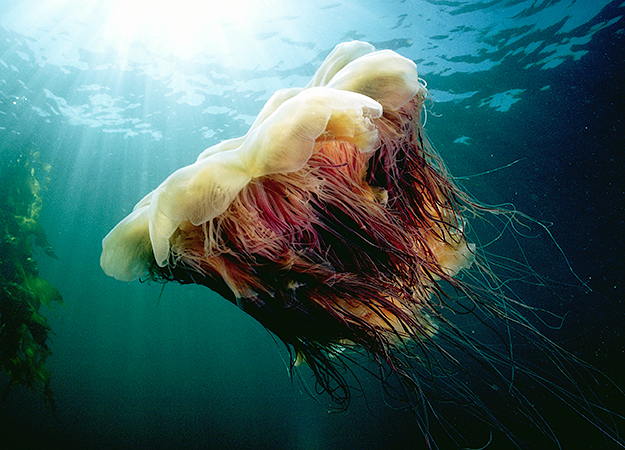
The Lion's Mane Jellyfish


This huge jellyfish, confined to the icy waters of the Antarctic, gently propels itself through the water, expanding its pink folds into an umbrella shape. They get their name from the fact they've got loads of long, thin hair like tentacles. For most of their lives, they swim close to, or at the bottom of the ocean, feeding on shrimp, zooplankton and other small fish. It feeds in a number of different ways, from killing small animals with stinging cells on their tentacles. As far as human contact is concerned, stings just cause localised redness and temporary pain- in healthy people their stings aren't known to be fatal. Vinegar can also be used to 'deactivate' the sting but due to the large number of tentacles, you need to seek medical attention straight after exposure. In 2010, it was estimated that 150 people were thought to have been stung from the remains of a lion's mane jellyfish which had broken up into countless pieces on the coast of New Hampshire in the US.  Given the sheer size of the jellyfish, scientists reckon that the incident was probably caused by just one jellyfish.


Wednesday, 16 September 2015

Finding Nemo....


.... or a clownfish! :)

The clown fish (also called anemone fish) are actually more or less all identical but they have subtle differences in shape and live in different habitats. Of all the fish, they're probably the most recognizable, mainly for the obvious movie connections! Before they take up residence, they perform a dance with another fish, gently touching the other fish until they become acclimatized to the nearby fish. They also have a layer of mucus on their skin to make it immune from the anemone's sting. As far as fish are concerned they can live for a surprisingly long time - up to 10 years in the wild!

Weirdly, all clown fish are born male and have an ability to change sex, although just to become the dominant female. However they can't switch back.


Thursday, 3 September 2015

UK BLUE WHALE ALERT | #BigBlueLive


It's only been days since the entire British public was enthralled by the appearance of a Blue Whale on camera just off the Californian Coast, but it appears that they've been following us to the UK! In fact, this blue whale made an appearance 250 miles off the south west coast of the UK, which is actually a relatively small distance as far as scientists are concerned. Many Oceanographers have actually said they think it's one of the first images they've been able to capture since the Blue Whale was hunted to near extinction many years ago. The Oceanographers who saw the whale where actually doing a marine mammal survey when they saw seven fin whales when one of the researchers spotted the whale about a kilometer away from the boat.

Blue Whales are probably the biggest mammal which has ever lived on Earth - with one huge krill obsession! In one single day, they can consume about 3,600kg of krill! They spend most of their time underwater when they're diving for krill, then surface every few minutes to take a breath - lets face it, Blue Whales are AMAZING!

For more information click here


Tuesday, 25 August 2015

The Leafy Sea Dragon | #WeirdestAnimals


The Sea Dragon, hidden in the depths of the ocean and one of the most camouflaged species on the planet -  not many people have actually seen this sea dragon. Living in the waters off the coast of the East and South  Australia they're often recognized by their reddish color and their long and thin snouts. Surprisingly, their snout actually helps propel them through the water, tumbling like seaweed drifting through the oceans. Like sea horses, it's actually the males which are responsible for childbearing, instead of a pouch they have a patch on the underside of their tail where females deposit their bright pink eggs. They then release the miniature sea dragons after about 5 weeks.
Unfortunately, they're actually endangered as divers often take them as pets, so much so the Australian government actually put complete protection on them in the early 1990s - but it might not be too late.

Sunday, 23 August 2015

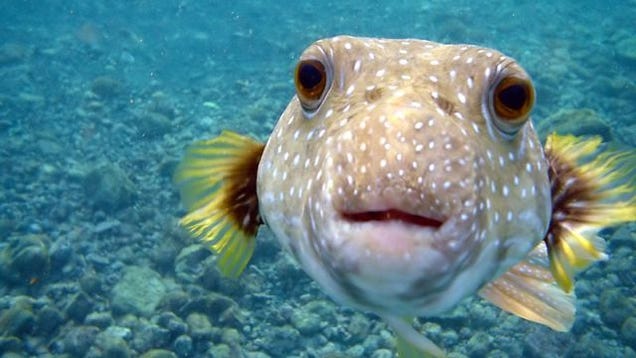
The Puffer Fish | #WeirdestAnimals


Not you're average looking fish, the puffer fish is known for it's ability to undergo a complete body transformation in seconds. In fact, they're so unique that there's around 120 different species of Puffer Fish that mostly reside in the tropical waters of the Indian, Atlantic and Pacific Ocean. Despite their somewhat intimidating shape their size is extremely changeable - from one inch to two feet, all in an effort to scare their predators.

Stay away from them though, as they contain a toxin 1200 times stronger than cyanide, which is enough to kill 30 adult men! Despite the toxin, in Japan, some parts of the fish area actually a delicacy, although you have to be specially trained to prepare it otherwise you might end up killing someone! But of course the toxin does out predators off them, the only species that's immune to the fish is a shark, so in many ways they're quite safe in the oceans!

They also have a body perfectly adapted for a life at sea for example, they have four teeth, fused in a beak like structure ideal for opening mussels, clams and other shellfish. They've also got excellent eyesight so they can spot predators from afar. All in all they're pretty amazing fish, but I'd stay away if I was you!