Total Pageviews

Showing posts with label animal. Show all posts

Wednesday, 30 March 2016

Marmosets | Animal Profile


Marmosets, are very small, but very cute monkeys. They're only around 22cm long, there's about 22 subspecies of them.

Compared to other monkeys, they show some very different features, they have claws rather than fingernails and strong hairs on their wrists. Unlike us, they don't have any wisdom teeth. 

Their body temperature is unbelievably variable, changing by up to 4 °C in a day. Marmosets are native to South America and have been found in Bolivia, Brazil, Colombia, Ecuador, Paraguay and Peru although they've been spotted in Central America and Mexico. Unfortunately, they have also been raised as pets.

Monday, 19 October 2015

The Lemon Shark


Sharks are one of the most well known marine predators, however they're experiencing a huge worldwide decline. Scientists have estimated that around 90% of the world's marine predators have been lost from our oceans since 1950. This loss is primarily due to overfishing and was entirely preventable. The demand for shark products on Asian markets are ever increasing - sharks are also suffering from habitat loss. Many shark species use specific areas such as waters and surrounding mangroves.

Bimini is an island surrounded by mangroves. In fact, the island is the westernmost district of the Bahamas - 53 miles due east of Miami. The island is actually the closest point within the Bahamas to the US. Because of its healthy marine ecosystem it's a tourist hot spot. The surrounding mangroves provide nursery areas for sharks, other fish, conch and lobster. The lemon shark is perhaps one of most significant nearby species. The lemon sharks have been studied by the Bimini Biological Field Station for over 25 years. They're large species at the top of the food chain - this makes them the apex predator. They are fully grown at about 12-15 years. Once they reach this age, they're sexually mature. From here, they pup every two years for the rest of their life. The usual litter size is between 4 and 18 young. These sharks can live for over 30 years. They can grow a staggering 3 metres long. As part of their research, the scientists tag the sharks to monitor their movement and behaviour. As a result of this tagging it was found that they actually travel very long distances, one individual was tracked for over 1000km. The main idea is that once they've tagged the shark, scientists can look at how the shark behaves and interacts with the oceans.


Sunday, 20 September 2015

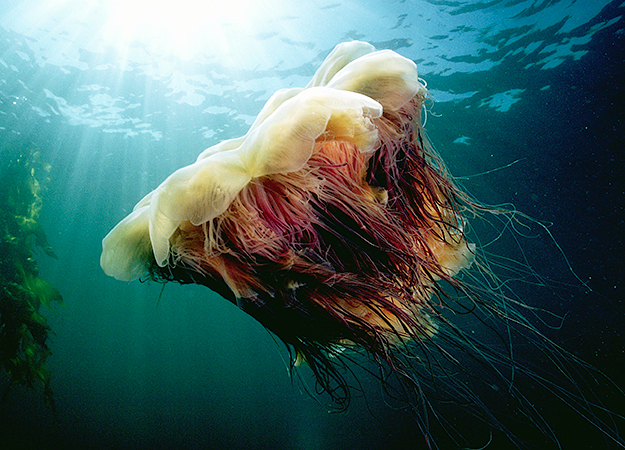
The Lion's Mane Jellyfish


This huge jellyfish, confined to the icy waters of the Antarctic, gently propels itself through the water, expanding its pink folds into an umbrella shape. They get their name from the fact they've got loads of long, thin hair like tentacles. For most of their lives, they swim close to, or at the bottom of the ocean, feeding on shrimp, zooplankton and other small fish. It feeds in a number of different ways, from killing small animals with stinging cells on their tentacles. As far as human contact is concerned, stings just cause localised redness and temporary pain- in healthy people their stings aren't known to be fatal. Vinegar can also be used to 'deactivate' the sting but due to the large number of tentacles, you need to seek medical attention straight after exposure. In 2010, it was estimated that 150 people were thought to have been stung from the remains of a lion's mane jellyfish which had broken up into countless pieces on the coast of New Hampshire in the US.  Given the sheer size of the jellyfish, scientists reckon that the incident was probably caused by just one jellyfish.


Sunday, 13 September 2015

Mini Pigs!


Since our visit to the Countess of Warwick Country Show a couple of weeks back where we saw pigs and their piglets, I began wondering about Mini Pigs (partly as they definitely have the cuteness factor! However you might be looking at a very hefty price tag, because they're so social they really need to be bought in pairs - however, they are hypoallergenic! These pigs are also surprisingly intelligent and, if I'm honest - dog like! They can solve complex problems, swim, dream, understand names, have an amazing memory - scientists have even found that they can be smarter than an average 3 year old child! What's even better is that they've got a great sense of direction so they can find their way back home from a fair distance away. However, sometimes they can grow bigger than promised, so sometimes owners abandon them - which of course leaves a bigger problem for the pig- where does the pig go now?

Sunday, 6 September 2015

Bergamasco Shepherd

These are actually one of the strangest dogs I've EVER heard of! Looking at pictures them, they kind of look like someone has just made a model dog out of fabric ends! Apologies if you have one - I'm not saying their bad at all or don't look good, they just aren't your typical dog! This type of dog is an ancient breed which scientists think are around 2000 years old. Its thick hair actually serves a huge purpose! The thick covering of hair over their eyes means that they don't get dazzled by the sunlight reflecting off the snow. The color of their coat also serves as camouflage as they can blend into the mountains. Even to this day, they haven't changed and they still have their same, unique coat. Also, just in case you were wondering, they're hypoallergenic so perfect for people who are allergic to dogs!


Wednesday, 2 September 2015

The Sea Life Trade!


Next time you hit the beach (admittedly, it is autumn so you might not be doing that for a while!) watch out for nearby shops selling dried seahorses, shells or even Puffer Fish. Sea horses are amazing creatures found across the world. Unfortunately, their body shape means they're not particularly good swimmers so they can easily die of exhaustion, which, of course means that they're vulnerable to trade like this.

A campaign by the amazing Seahorse Trust thinks that millions of them could be illegally imported over the internet which could be driving some species to extinction!!! It's not necessarily that shop owners know that it's illegal, it's just cheap and gets them money. Even though it might not seem like there's much we can do, there's something everyone can do - just don't  buy them in the shops! Then we can starve the trade of money so it will stop!

Make sure you check out The Seahorse Trust: www.theseahorsetrust.org

Saturday, 29 August 2015

The Secret Lives of Hedgehogs

Although we may be limited to the odd pigeon or garden bird where we live, the one thing I do remember from years and years ago is rescuing a hedgehog or two that had either been injured or had just gotten a bit lost. Now, however we don't see them, really at all- but like most animals, I suppose it's a case of if there's no food and no appropriate habitat, they'll move on! One thing I was surprised to find out, is that they can't actually drink milk because it gives them diarrhea! Our spiny friends live a pretty amazing life, they're quite sociable and live in packs called an "array", unfortunately many people want to keep hedgehogs as pets, so much so the authorities have got involved - they're now banned in New York, Arizona, California and Hawaii because their governments classify them as wild animals, so for obvious reasons, they can't be kept domestically. Most Hedgehogs also disappear for Winter, making them only one of three species in the UK that hibernate. Luckily, they're pretty much immune to snake venom so they can also stay safe. Whatever happens to our hedgehogs, here in the UK and the US, one thing's for sure is that one legacy they have left, is that the sea urchin was named after them!
Hedgehogs live a surprising life in the US. Because of this craze in the US, with keeping Hedgehogs as pets, there is such a thing as the Hedgehog Olympic Games (it is true, I promise!!) featuring some pretty crazy events like sprints and hurdles in Illinois in the US. You'll be pleased to hear however it's not happening now as many organisations got involved and rightly deemed it unfair on the hedgehogs!!

Friday, 21 August 2015

The Pink Fairy Armadillo | #WeirdestAnimals


This strange Armadillo is actually the smallest kind of Armadillo with a strange fashion sense - they've got very light pink scales and fluffy white fur underneath, mostly smaller than 10cm long. They actually reside in the dry grasslands and sandy planes of central Argentina and are surprisingly skilled at digging burrows beside large ant colonies, partly as ants provide a plentiful food supply for the armadillo. When they dig, they use their large front claws to effortlessly move through the sand. They even live a life surprisingly similar to the mole, they only come out of their burrow to feed at night and are very solitary animals.


Wednesday, 29 July 2015

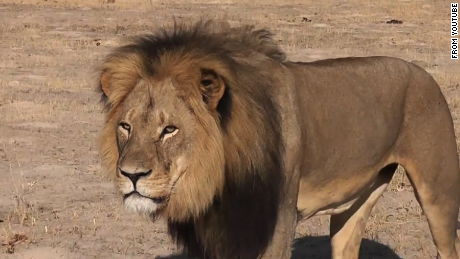
RIP Cecil

If you haven't already heard, Cecil, one of Zimbabwe's most famous lions was killed by a hunter on a hunting trip. Yesterday he paid £638 to be released on bail and is returning to court on 5th August. The hunter, a dentist from Minnesota is attempting to defend his case having carried out an unlawful hunt. Animal hunting is becoming an ever increasing problem as there are companies who hold both lawful and unlawful hunts on animals across the world and Africa, although one of the main issues with this is how do you put a price on these hunts - it's not just time and the materials but the cost of nature too. You also have to bring the characteristics of the animals into consideration. For example, Cecil was renowned for being friendly towards visitors which generated much needed tourism, particularly in a place where there's not a thriving economy. In Cecil's case he was partly driving tourism in Hwange National park - one of Zimbabwe's largest game reserves. Partly because he led two prides of lion's containing six lionesses and 12 cubs, Oxford University was studying him. The fact he was involved in scientific research also makes the problem far more complex because how can you price knowledge and further scientific developments which arise from that? The simple answer is, you cant.
What makes Cecil's death even worse is people hunt animals not just because of the 'pleasure' they get from the actual act of hunting they treat the animal that's died like a trophy - like a competition they've won. In fact, around 665 lions in Africa are killed every year for a "trophy". And sadly,Cecil's body was found skinned and beheaded according to the Zimbabwe Conservation Task Force (ZTCF). A representative from ZTCF said that Cecil never bothered anyone and a beautiful animal. Personally I think it's more about the circumstances he was killed - the killers tried to remove the GPS tag Oxford University had installed, he was treated badly after his death. And above all lions are worth so much, from tourism, to status. Whatever anyone thinks, Lions or any animal for that matter shouldn't be killed as a competition or should have a bad death or be treated badly after they've died.


#RIPCecil

Wednesday, 8 January 2014

Meet the Piglet Squid

The Piglet Squid (BBC Focus Magazine)
This is the Piglet Squid (Heliocranchia pfefferi) which always has a smile on his face! The tentacles seem to form a mass of curly 'hair'. The squid is roughly the size of a small avocado and is common in deep water in virtually all oceans. It lives at depths of around 100m or 320ft.
 
The piglet squid is a slow swimmer but ammonium ions in its body fluid help to keep it buoyant. A large light-producing organ (photophore) is located beneath each of its large eyes.