The DISCOVERY Expedition
1901-04
Scott went on leave for a few weeks to prepare for the expedition. He then started work by taking a course in magnetism at Deptford. Before he set sail he was living with his two sisters and mother over the shop in Chelsea. Scott started his day by jogging across Hyde Park for exercise. He plunged himself into the planning of the expedition. Some extraordinary details had to be worked out and even Hugh Robert Mill, distinguished librarian of the Royal Geographical Society (1892-1900), thought that Scott "if anyone, could bring order out of the chaos which had overtaken the plans and preparations".
The Crew
The Crew began to be appointed on May 29, 1900 Albert Armitage was appointed to serve as second-in-command and navigator. Armitage, aged thirty-six, came from the Merchant Navy where he had been an officer in the P and O fleet. His previous experience came from his participation, as navigator, with the Jackson-Harmsworth Arctic expedition in 1894.
The doctor on the Jackson-Harmsworth expedition had been Reginald Koettlitz, a six foot tall man with drooping mustaches of German heritage. At the age of thirty-nine, Koettlitz received his appointment in 1900. Markham described him as "a very honest food fellow, but exceedingly short of commonsense". However, Koettlitz was in agreement with other notable doctors that scurvy (caused by a vitamin C deficiency), the plague of all polar expeditions, was caused by a poison resulting from a diet purely consisting of preserved food. The remedy being freshly cooked and prepared pure food.
The assistant surgeon was a young man recently qualified at St. George's Hospital. He had a wonderful talent for drawing and painting in water colors, was a religious man and had a huge passion for birds.
His name was Edward Adrian Wilson, son of a doctor in Cheltenham. As a courageous young man, Wilson spent too many chilly nights bird-watching, too many long nights with his studies to make up for time spent in art galleries, too much starving himself so he could give money to beggars or to buy books, and probably too much smoking. This had totally ruined his health and as a result he contracted pulmonary tuberculosis. After he spent two years in Norway and a Swiss sanitarium. He did manage to recover from the disease but as soon as he began his duties as junior house surgeon he contracted blood poisoning which resulted in a painful abscess in his armpit. When Scott met him in 1900, he was obviously still in a bad way and his arm was still in a sling. To many peoples suprise, Scott appointed him on the spot but he still had to pass an Admiralty Medical Board.
He failed the first time and the second exam, only weeks before sailing, reported "Mr. E. A. Wilson unfit on account of disease in the right lung". Scott told Markham he must have him and Wilson told Scott "I quite realize it will be kill or cure, and have made up my mind that it will be cure". Dr. Wilson's contributions to the expedition were enormous and his incredible gallery of original artwork left for our enjoyment is highly prized and very valuable.
Scott then went to appoint other commanders for the ship still leaving three scientific positions to be filled. The first of which was offered to a Scot, W.S Bruce, unfortunately he was busy organising his own expedition (the SCOTIA in 1902) so he therefore declined. The position was then offered to Thomas Vere Hodgson who was 37 and a director of the marine biological laboratories in Plymouth. Secondly a geologist was also appointed, Hartley Ferrar (22). The last position to be filled was in fact a physicist, Louis Bernacchi (25) whose appointment was so late coming that he had to join the ship in New Zealand. he spent a very adventurous childhood on a mountainous island that was uninhabi His father was a silk merchant from Lombardy and he brought an island from the Tasmanian Government for £20,000.
Discovery, by E. A. Wilson
|
. The position was then offered to Thomas Vere Hodgson, aged thirty-seven, director of the marine biological laboratories in Plymouth. ("Young to have a polished bald head, sometimes needing a skull cap, but otherwise apparently strong and healthy" as Markham wrote).
The geologist, Hartley Ferrar, aged twenty-two, had just graduated from Cambridge with an honor's degree. Born in Ireland and raised primarily in South Africa, Markham felt he was capable but "very young, very unfledged, and rather lazy; however, he most likely could be "made into a man in this ship" by "the young lieutenants".
The physicist was Louis Bernacchi, aged twenty-five. His appointment was so late in coming that he had to join the ship in New Zealand. He had spent a very adventurous childhood on a mountainous island that was uninhabited except for his family and their dependents. His father was a silk merchant from Lombardy and had bought the island from the Tasmanian Government for £20,000. Louis studied physics and astronomy at the Melbourne Observatory and was the only member of the expedition to have prior experience in the Antarctic. |
L to R: Lt. Armitage, Lt. Mulock, Lt. Shackleton, Dr. Wilson, Lt. Skelton, Capt. Scott,
Lt. Royds, Dr. Koettlitz, Mr. Bernacchi and Mr. Ferrar on board Discovery
|
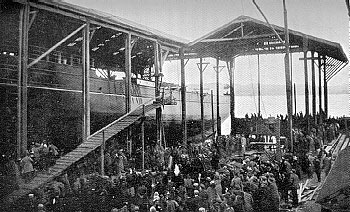
The DISCOVERY was built at Dundee. She was the sixth of her name and the first to be specifically designed and built for scientific work.
- She had to be a wooden ship to withstand the pressure of the ice since steel would simply buckle. The ship was to be exceptionally strong, built from a variety of timbers:
- English oak for the frames, eleven inches thick; Riga fir for the lining, eleven inches; Honduras mahogany, pitch pine or oak for the four-inch-thick lining, all sheathed with two layers of planking--twenty-six inches of solid wood in all. Her bow was incredibly strong; some of the bolts running through the wood were eight and a half feet long. The vessel was 172 feet long and 34 feet wide.
- She had to have room to store fuel, oil, 350 tons of coal, fresh water, dog food, medical supplies, scientific instruments, axes and saws, a sectional wooden hut, a piano and a library.
- The final cost, including engines, was £49,277.
- Food for the 47 men was stored aboard: 150 tons of roast pheasant, 500 of roast turkey, whole roast partridges, hare, duck and green peas, rump steak, wild cherry sauce, celery seed, black currant vinegar, candied orange peel, Stilton and Double Gloucester cheese, 27 gallons of brandy, 27 gallons of whiskey, 60 cases of port, 36 cases of sherry, 28 cases of champagne, lime juice, 1800 pounds of tobacco, pemmican, raisins, chocolate and onion powder.
On March 21, 1901 Lady Markham, with a pair of golden scissors, cut the tape and the DISCOVERY was launched.
|
|
 |
| Discovery launched March 21, 1901 |
The huge quantities of food meant that the DISCOVERY was so heavy in the seas that she could not make more than seven knots. This was an immediate concern as New Zealand was 14,000 miles away.
Her first stop was at Madeira Island where they would take on more coal. After leaving Madeira, the men were shocked to find that the DISCOVERY was leaking water into the hold and, as a result, had ruined a significant amount of food. What could be dried was saved and the rest was thrown overboard. The ship, which then arrived in Cape Town on October 3, 1901 where nearly everyone proceeded to get drunk. Owing to the slowness of the voyage, Scott decided to cut out part of the journey and sail directly to to Lyttleton, New Zealand. As a result of this decision, Dr. Murray was left in Cape Town so that he could return to his post at the British Museum.
The vessel arrived at Lyttleton at the end of November where the attention was at last paid to the leak.
Scott wrote that the drunken men "disgust me, but I'm going to have it out with them somehow"
While in New Zealand the men had decided that a relief ship would be needed to resupply the DISCOVERY in the following year.
Then just before midnight on 8th Janguary 1902 they had crossed the Antarctic circle.
|
|
When they reached the summit, a blizzard came up and reduced visibility to nearly nothing. They pitched their tents and since they couldn't get their cookers to work, frostbite began to set in. An experienced crew would have remained, no matter how uncomfortable, but as a novice crew, they decided to head out into the storm. They soon found themselves on a steep slippery slope where Evans stepped on a patch of bare ice and tumbled out of sight. Barne sat down and slid after him with Quartley following close behind.
All three men miraculously came to a halt when a patch of soft snow stopped them at the edge of a precipice with the sea pounding below. A howling dog flashed past and disappeared over the edge. Frank Wild took charge of leading the remaining five who were left at the head of the slope. He led them off in the direction of the ship but suddenly came upon a cliff with the dark sea below; another step and he would have gone right over the edge. Unfortunately, Vince could get no grip on the slippery ice and, like the dog, he vanished over the edge and into the sea. Wild, Weller, Heald and Plumley were able to fight their way back to the ship.
Of the original twelve, only four had returned.
A search party was quickly organized and two days later a figure came walking down the hill towards the ship. Incredibly, it was Hare and with not even a trace of frostbite. It seems he had fallen down and simply gone to sleep. The snow covered and preserved him as he slept for thirty-six hours!
One more sledging trip was undertaken before winter set in. On Easter Monday, Scott started off with Armitage, Wilson, Ferrar and eight men with three sledges and nine dogs. The objective was to lay depots towards the south for use of the sledging parties in the spring. The dogs refused to work , partly as the temperature had dropped to -47°F!
When they became exhausted, the men crawled into their sleeping bags.
As Wilson put it, "Once in, one can do literally nothing but lie as one falls in the tent. Reindeer skin hairs get in your mouth and nose and you can't lift a hand to get them out". At night the men would sweat which would produce a puddle beneath them and since nothing could be dried, by morning "you put on frozen mitts and frozen boots, stuffed with frozen grass and rime. There's a fascination about it all, but it can't be considered comfort". Two more days of this and Scott decided enough was enough. They packed up their gear and headed back to the ship with everyone learning from this experience.
On April 23, 1901 the sun sank below the horizon and would not reappear for more than four months.
"...it can't be considered as comfort" ~ Wilson
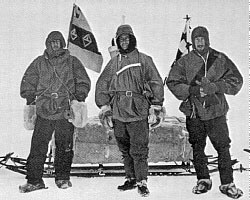
Left to Right: Shackleton, Scott, Wilson
| 
|
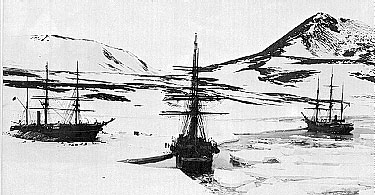
 TERRA NOVA and MORNING reach the DISCOVERY TERRA NOVA and MORNING reach the DISCOVERY
| |
"There has been nothing but a common desire to work for the common good".
On 7th November, Scott gave his first big lecture to 7,000 invited members and guests of the two Societies at Albert Hall. Now the praise was raining down for Scott. He was awarded the Patron's Gold Medal of the RGS, was made a member of the French Legion of Honour amongst many others. His most prized including an honorary degree of Doctor of Science from Cambridge University. When he left London he headed for Edinburgh for more lectures and the Royal Geographical Society's Livingstone Medal.
Meanwhile, many pleaded with the Government to retain the DISCOVERY for future polar work but his remarks fell on deaf ears. The ship used in the voyage was sold to the highest bidder, the Hudson's Bay Company, for £10,000, about one-fourth her original cost.
Scott continued to travel around the country giving lectures and making preparations to publish a book about the expedition.
Scott wrote, "Of all things I dread having to write a narrative and am wholly doubtful of my capacity; in any event if I have to do it, it will take me a long time. I have not...the pen of a ready writer".
By the start of 1905 his book was nearly completed. On October 12, 1905, in an edition of 3000 copies, the Voyage of the Discovery was published. An incredible piece of work, the two-volume edition was profusely illustrated with Wilson's drawings and Skelton's photographs from the expedition. Scott needlessly worried about his abilities for writing as nearly all the critics praised it. His former crewmembers each received a free copy and they all loved it.
Scott even insisted on sending Wilson a check for £100 as a fee for reproducing his drawings; Wilson refused but Scott made him take it anyway. (Today, a single one of his drawings can fetch $10,000 or more.) The book sold reasonably well; the first edition sold out immediately so 1500 more copies were printed the following month. But then the sales fell dramatically; when the book went out of print in 1919, total sales amounted to 5,272 copies.
Scott's home in Chelsea, London can be found standing today, marked by a blue commemorative plaque on 56 Oakley Street.
Scott was single and thirty-seven years old when, in April 1906, he announced at an RGS meeting that:
"I am sorry to say that my lines are cast in such places that in all probability I shall not return to those regions". But there was a great deal of emotion as in the same speech he touched on "those fields of snow sparkling in the sun, the pack-ice and bergs and blue sea, and those mountains, those glorious southern mountains, rearing their heads in desolate grandeur. The movements of the pack, those small mysterious movements with the hush sound that comes across the water, and I hear also the swish of the sledge...I cannot explain to you, they will always drag my thought back to those good times when these things were before me".
|

 Polar Bears in the UK? Sounds strange but we're going to try and breed them in Scotland later this year. The last time we attempted to breed Polar Bear cubs was 25 years ago.