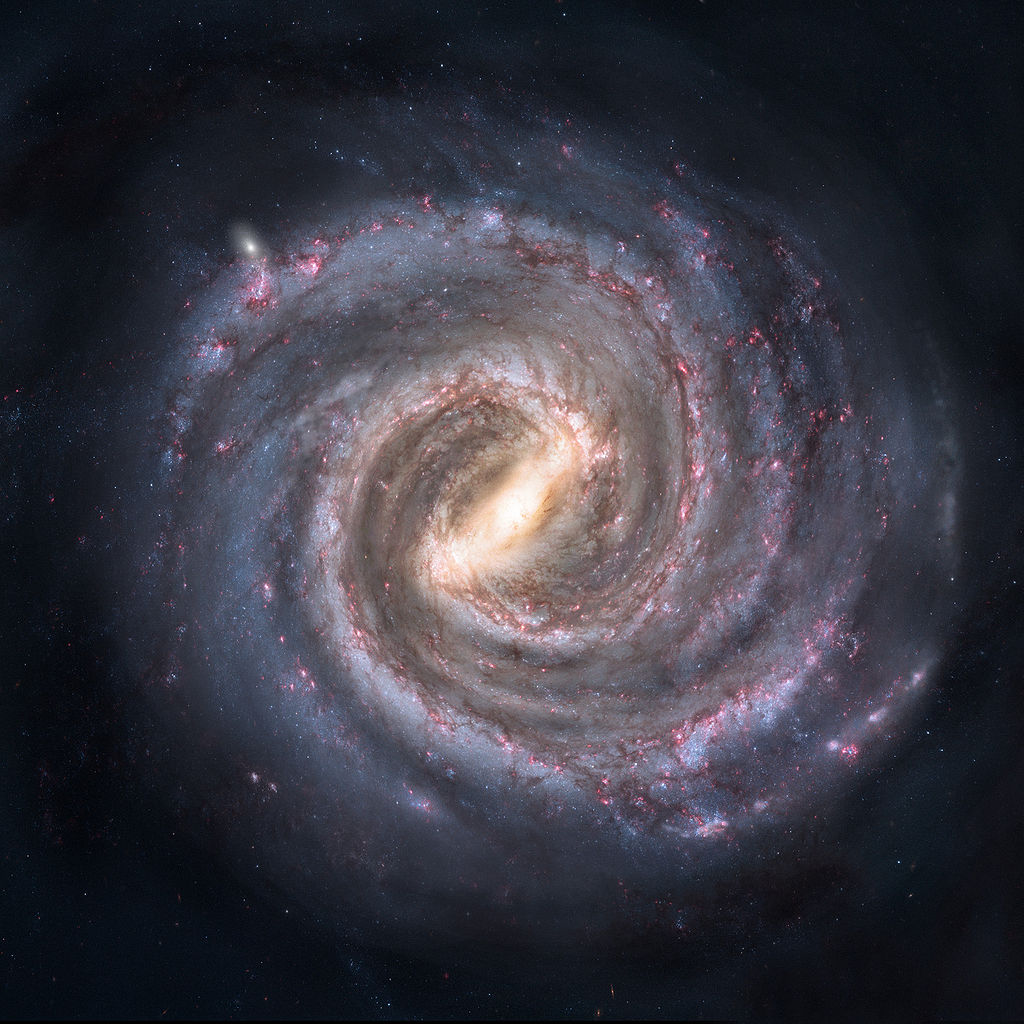
Well, they collide due to their 'mutual gravitational attraction' in other words they collide because gravity draws them together. However in general galaxies are moving away from each other at an ever increasing rate, basically because of the Universe expanding at an ever increasing rate. This can be modeled simply by drawing stars or dots (imagine these as galaxies) onto a deflated balloon then blowing up the balloon. An idea that has sprung from this is the Red Shift. This is where astronomers have found that the further away a star is the more it's light has been red shifted. So this tells us that distant galaxies are moving away from us and that the further away a galaxy is the faster away its moving away from us.
The Red Shift is an example of the Doppler effect, named after the Austrian physicist Christian Doppler who proposed this theory in 1842 in Prague. You may have noticed that as a police car comes towards you the siren becomes high pitched and low pitched as the car drives away. This effect is where there is a change in frequency and wavelength. So when a source moves towards an observer the observed wavelength decreases and frequency increases and vice versa. In terms of Astronomy the results of the Doppler effect are used to identify if a nearby star is what astronomers call a binary star. This is two stars orbiting around a 'common center of mass' which is where the relative position of the distributed mass adds to zero. The brighter star is called the 'primary star' and the other the 'secondary star'
In our own 'Local Group' of galaxies for example some of the galaxies are moving away from us and some are moving towards us. Take our nearest galaxy the Andromeda galaxy for example which is currently moving towards the Milky Way at 402, 336 km/h and is due to hit us in 4 billion years.