Total Pageviews

Showing posts with label way. Show all posts

Saturday, 26 July 2014

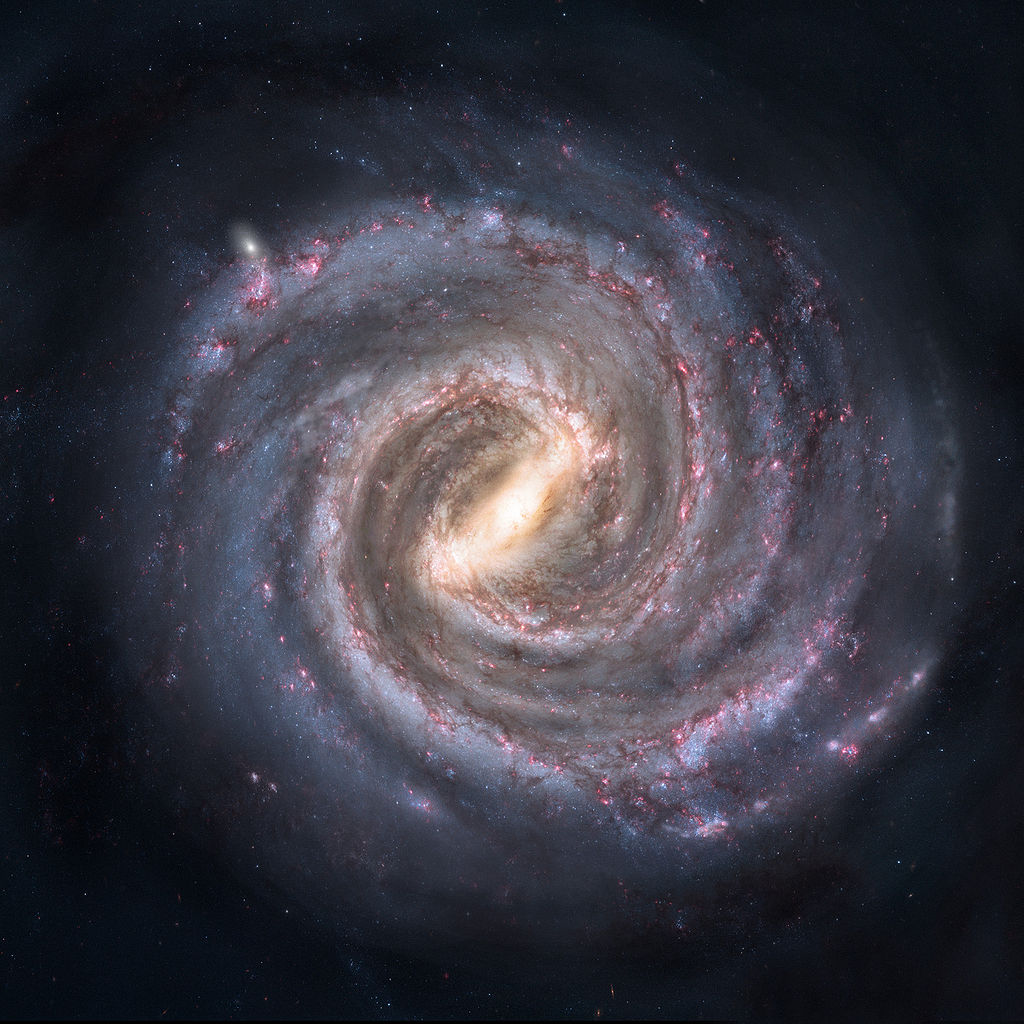
How do we know what the Milky Way looks like?

You're right, it's really difficult to deduce the shape of the Milky Way, the main reason of course being that we're in it! On the other hand, astronomers can map the distribution of the stars and motion of them really easily. This research indicates that we're orbiting a 'central bulge' , this means the planets and stars are distributed along a thin plane. The most convincing evidence for the structure of the Milky Way comes from the studies of gas clouds - here they measure the velocities and positions of these clouds. So although we know we have spiral clouds - we have no idea how many spiral arms there are!


Follow the rest of my #SummerofScience and me on Twitter @Sci_Sparks. Don’t forget to download my charity eBook, Science Bites: A Short Tour of the Universe HERE

Monday, 20 January 2014

Could a planet exist without a Sun?

Yes planets can definitely be "free floating" without a star. These type of planets may have been ejected from their first, original star system. Scientists often refer to this as "rouge planets" or "normad" planets. Another way they can form is by the condensation of material in much the same way as stars themselves. These are normally called "sub-brown dwarfs".  The closest rogue planet to be discovered yet is 'S Ori 52' a member of the Orion star system and is around 80 light years away. Some recent studies have suggested that there might be more free floating planets in the Milky Way than stars!

An example of a rogue planet

Saturday, 19 October 2013

Why do galaxies collide?

Well, they collide due to their 'mutual gravitational attraction' in other words they collide because gravity draws them together. However in general galaxies are moving away from each other at an ever increasing rate, basically because of the Universe expanding at an ever increasing rate. This can be modeled simply by drawing stars or dots (imagine these as galaxies) onto a deflated balloon then blowing up the balloon. An idea that has sprung from this is the Red Shift. This is where astronomers have found that the further away a star is the more it's light has been red shifted. So this tells us that distant galaxies are moving away from us and that the further away a galaxy is the faster away its moving away from us.

The Red Shift is an example of the Doppler effect, named after the Austrian physicist Christian Doppler who proposed this theory in 1842 in Prague. You may have noticed that as a police car comes towards you the siren becomes high pitched and low pitched as the car drives away. This effect is where there is a change in frequency and wavelength. So when a source moves towards an observer the observed wavelength decreases and frequency increases and vice versa. In terms of Astronomy the results of the Doppler effect are used to identify if a nearby star is what astronomers call a binary star. This is two stars orbiting around a 'common center of mass' which is where the relative position of the distributed mass adds to zero. The brighter star is called the 'primary star' and the other the 'secondary star'

In our own 'Local Group' of galaxies for example some of the galaxies are moving away from us and some are moving towards us. Take our nearest galaxy the Andromeda galaxy for example which is currently moving towards the Milky Way at 402, 336 km/h and is due to hit us in 4 billion years.

Saturday, 21 September 2013

The People Who Want to go to Mars (And Never Return)

It’s safe to say that the majority of scientists worldwide believe that there is life way beyond Earth, but would you want to travel the 140 million miles to get to Mars and regularly endure the temperatures of -153oC at the poles of Mars? Well, tens of thousands of people have applied and prepared to leave their families, jobs and lives behind for a one-way trip to Mars all to never return to Earth.

Home to the solar system’s biggest volcano, Olympus Mons, Mars has  around 687 earth days each year and at night, the surface temperature of Mars in the summer can get as low as -53oC. Rovers on Mars have even discovered Martian spherules which have been nicknamed ‘blueberries’ which may even unlock the key to the elements that Mars once had, although scientists haven’t discovered these for certain yet although they do know that these spherules are iron rich. This is also shown because of Mars’ classic red colour which shows an extremely high percentage of iron

This “Mars One” mission (launched back in May 2012) aims to send humans on a one- way trip to the Red Planet. You might think that this amazing opportunity is a science-fiction story and wouldn’t happen for a good while yet but this programme aims to send a selected number of the public up to Mars by 2023, fully equipped with the right training needed to survive on Mars. Anyone worldwide over 18 was eligible to apply for the trip and 202,589 applications were received throughout the application process!

The selection process consists of three rounds including an interview with the ‘Mars One’ committee members and a series of challenges to prepare candidates for the potential mission that will be broadcast on TV and online.

The brave volunteers will be sent in groups of four, starting with two men and two women from four different continents. From 2023 when the first group is sent up, ‘Mars One’ (the company organising the trips) are planning to send an extra four up every two years!

However the trip isn’t without its risks, radiation exposure is particularly a concern as it can lead to an increased cancer risk, lower immune system and possible infertility. This could mean that before the applicants reach Mars, their health may be worse than when they took off from Earth! Being on Mars they wouldn’t have access to doctors and hospitals so would need to manage their own health using restricted medical supplies.


The Dutch group wants to launch a supply mission to land on Mars as soon as October 2016, and then another mission that they have called a ‘settlement rover’ to land in 2018. By 2033 the colony could reach 20 settlers on the Red Planet, although the mission could prove very costly! NASA spent £1.8 billion on Mars’ Curiosity Rover which is the biggest most advanced Rover to travel across Mars, but ‘Mars One’ has a budget of £4 billion for this project but it could prove the most worthwhile and open up so many more opportunities and avenues for exploration in science.